Task notification, marking criteria and client memo
ASSESSMENT TASK NOTIFICATION
Local councils across NSW collect and report library statistics to track service performance and guide community investment annually. In this task, you will be an independent data analyst for Penrith City Council. By analysing 2024-25 data, you will evaluate how effectively Penrith’s library service is performing compared to other similar-sized councils, identify key reporting inconsistencies, and present evidence-based suggestions to the Council Committee.
Your task will be assessed according to your ability to:
- Explain relational database structures and justify an evaluation framework (Section 1).
- Analyse complex datasets, normalize data against similar councils, investigate inconsistencies, and construct a data chart (Section 2).
- Evaluate service effectiveness against established criteria, weigh stakeholder priorities, and justify recommendations (Section 3).
- Synthesise analytical findings and propose strategies for an executive audience in a formal report.
- Submit a consulting report of 1,500 to 1,900 words (excluding tables, figures and reference list).
- Include at least one data chart (e.g., comparative scatter plot).
- Cite all data sources and literature using APA 7.
As an independent data analyst for Penrith City Council, submit a consulting report (1,500-1,900 words) structured into three sections:
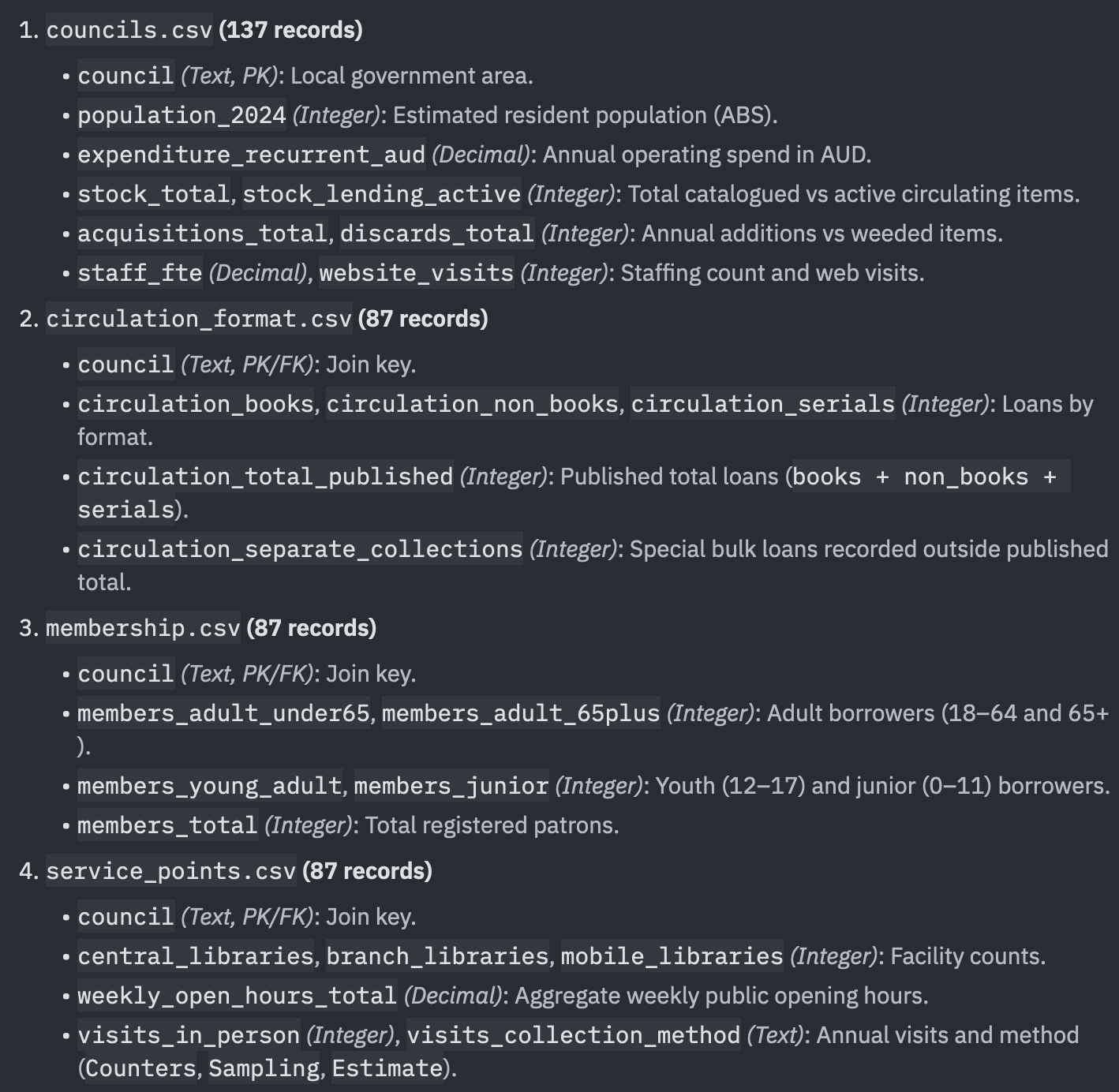
- Describe the four data tables: identify keys, data types, and relational links.
- Distinguish between what data fields measure and how stakeholders use them for decisions and subsidies.
- Identify key dataset stakeholders and their data needs.
- Define and justify 3 to 4 objective criteria to evaluate whether Penrith’s library service operates effectively.
- Analyse data tables using spreadsheet formulas (lookups, filtering, per-capita normalisation, and ratios).
- Compare Penrith against similar councils (e.g. similar size).
- Investigate and explain key data inconsistencies or reporting inconsistencies discovered across the tables.
- Construct and integrate at least one data chart (e.g., comparative scatter plot) that supports your findings.
- Synthesise analytical findings to evaluate overall service effectiveness against your Section 1 criteria.
- Propose and justify prioritised recommendations, balancing competing stakeholder needs.
- Evaluate dataset limitations and analytical assumptions.
Marking criteria · 40 marks
| Outcome | Criteria | Grade |
|---|---|---|
| EC-12-02, EC-12-04 | Explains comprehensively the relational architecture of the four tables, identifying keys and data types with thorough accuracy. Distinguishes clearly between what data fields measure and how stakeholders use that information for operational decisions and subsidies. Identifies and explains the specific operational data needs of diverse enterprise stakeholders. Defines and justifies 3 to 4 defensible, objective criteria to evaluate library service effectiveness. | 9-10 |
| Explains the relational links across the four tables, identifying keys and data types with sound accuracy. Distinguishes between what data fields measure and how stakeholders use them for decisions. Identifies the data needs of key enterprise stakeholders. Defines and justifies relevant criteria to evaluate service effectiveness. | 7-8 | |
| Describes basic table structures and identifies some keys or data types with minor inaccuracies. Outlines data fields with basic distinction between measurement and usage. Describes general stakeholder needs with limited specificity. Outlines basic criteria with limited justification. | 5-6 | |
| Recalls or lists isolated table names and fields with minimal understanding of relational links. Identifies data fields without distinguishing between measurement and practical application. Recalls few or no stakeholder data needs. Recalls arbitrary criteria with no justification. | 1-4 |
| Outcome | Criteria | Grade |
|---|---|---|
| EC-12-05, EC-12-10 | Critically analyses complex relational datasets using spreadsheet formulas (lookups, normalisation, ratios) with thorough calculation accuracy. Evaluates service performance by comparing metrics against a well-justified, defined peer cohort, identifying critical efficiency gaps. Investigates and explains key data inconsistencies across reporting tables through rigorous verification. Constructs an original, highly effective data chart that directly substantiates analytical findings. | 13-15 |
| Analyses relational datasets using spreadsheet formulas with sound accuracy. Evaluates service performance against a relevant peer cohort, identifying standard comparative patterns. Investigates and explains key data inconsistencies with sound reasoning. Constructs an accurate data chart that supports analytical findings. | 10-12 | |
| Applies basic spreadsheet formulas with some calculation or relational errors. Describes comparative patterns against broader averages with basic evaluation of performance. Describes prominent data inconsistencies with superficial explanation. Constructs a basic data chart that provides limited analytical support. | 6-9 | |
| Recalls raw values and basic formulas with limited analysis of complex datasets. Recalls isolated comparisons without structured peer evaluation. Identifies few or no data irregularities. Constructs an incomplete, inaccurate, or decorative chart. | 1-5 |
| Outcome | Criteria | Grade |
|---|---|---|
| EC-12-10, EC-12-11 | Synthesises analytical findings into a comprehensive evaluation of service effectiveness against criteria 1. Justifies prioritised, cost-neutral strategic recommendations, rigorously weighing competing stakeholder needs and constraints. Evaluates dataset limitations and analytical assumptions with thorough critical insight. | 9-10 |
| Synthesises analytical findings to evaluate service effectiveness against criteria 1. Justifies feasible strategic recommendations, assessing trade-offs between competing stakeholder priorities. Identifies and explains key dataset limitations and assumptions. | 7-8 | |
| Outlines overall service effectiveness with basic connection to established criteria. Proposes broad recommendations with limited consideration of trade-offs or budget constraints. Outlines general dataset limitations with basic understanding. | 5-6 | |
| Describes service performance with superficial connection to criteria. Recalls unfeasible or unsupported suggestions without addressing stakeholder needs. Identifies few or no limitations. | 3-4 | |
| Recalls raw observations without evaluative judgement. Proposes no actionable recommendations. | 1-2 |
| Outcome | Criteria | Grade |
|---|---|---|
| EC-12-11 | Demonstrates complex enterprise insights fluently in a professional report structure with clear logical cohesion. Applies a precise, audience-targeted register and terminology tailored to council decision-makers. Applies accurate APA 7 referencing for all data sources and literature. | 5 |
| Demonstrates enterprise insights clearly in a structured report format with sound logical flow. Applies an appropriate audience-focused register with minor lapses in professional terminology. Applies accurate APA 7 referencing with minor formatting errors. | 4 | |
| Demonstrates basic findings in a report format with inconsistent logical progression. Applies a generic register with limited translation of technical metrics for decision-makers. Applies basic referencing with frequent formatting errors. | 3 | |
| Demonstrates a fragmented report structure with informal register, making findings difficult to interpret. Recalls incomplete or absent references. | 1-2 |
Appendix
Mock Client Memorandum
Each year, our municipal library service reports operational data to the State Library of NSW. The 2024-25 public library statistics have now been released. Penrith City Council is currently developing its four-year strategic plan and needs an audit of our service performance. Penrith City Council would appreciate an assessment that is based on evidence regarding whether the library service offered by Penrith adds value to the community for the given population and budget.
Council faces several competing funding requests from internal teams:
- The Library Operations Manager wants to increase the budget for book purchasing both physically and digitally along with extended weekend library hours.
- The Youth Services Division is calling for a youth program in order to increase the number of teens participating.
- Council Finance notes that the $8.79 million in funding for Penrith's operation budget is a significant investment and needs to be proven efficient.
The council are unable to fund every request due to limited resource. Please examine the statistics and provide recommendations.
Director, Community Services
Penrith City Council
Dataset Definition
The data pack consists of four relational tables extracted from the NSW Public Library Statistics 2024-25 (State Library of NSW, 2026), joined on the primary key `council’. To best show the code part, the definition is written in Markdown and exported as images. In accordance with the State Library of NSW Copyright Policy (https://www.sl.nsw.gov.au/copyright), published statistical data is licensed under the Creative Commons Attribution 4.0 International Licence (CC BY 4.0) and reused in this assessment package under the research and educational provisions of the Copyright Act 1968 (Cth). All dataset extraction and educational adaptations are attributed to the State Library of New South Wales.